
Autonomous Marketing Infrastructure: Scale Your SaaS Growth in 2026
In the highly competitive digital landscape of 2026, standard marketing automation is no longer enough to maintain a competitive edge. Most modern enterprises are realizing that simply scheduling posts or setting up basic email autoresponders still requires massive human overhead, constant management, and continuous manual oversight. To break free from these operational limitations, forward-thinking organizations are deploying a complete, loop-based autonomous marketing infrastructure.
An autonomous marketing infrastructure represents a fully integrated, self-healing, and self-optimizing technical ecosystem where advanced AI agents take end-to-end responsibility for your growth channels. Instead of acting as tools that require human prompts, these agents operate within continuous data loops—researching trends, generating assets, publishing content, and capturing leads completely on autopilot. Here is how this next-generation infrastructure is redefining global SaaS growth.
—
What is an Autonomous Marketing Infrastructure?
Traditional marketing departments are heavily fragmented. A typical campaign requires an SEO analyst to find keywords, a copywriter to draft articles, an editor to review them, a visual artist to generate assets, and a community manager to syndicate the content across social channels. This manual pipeline introduces massive coordination friction, high payroll overhead, and severe execution delays.
An autonomous marketing infrastructure consolidates these separate human roles into a single, high-velocity digital workforce. By utilizing professional-grade, unified protocols, the infrastructure manages the entire customer acquisition lifecycle under one central system. This ecosystem never sleeps, never tires, and executes daily high-authority operations with mathematical precision, allowing founders to focus entirely on product development and strategic scaling.
—
The Anatomy of a Loop-Based Growth Engine
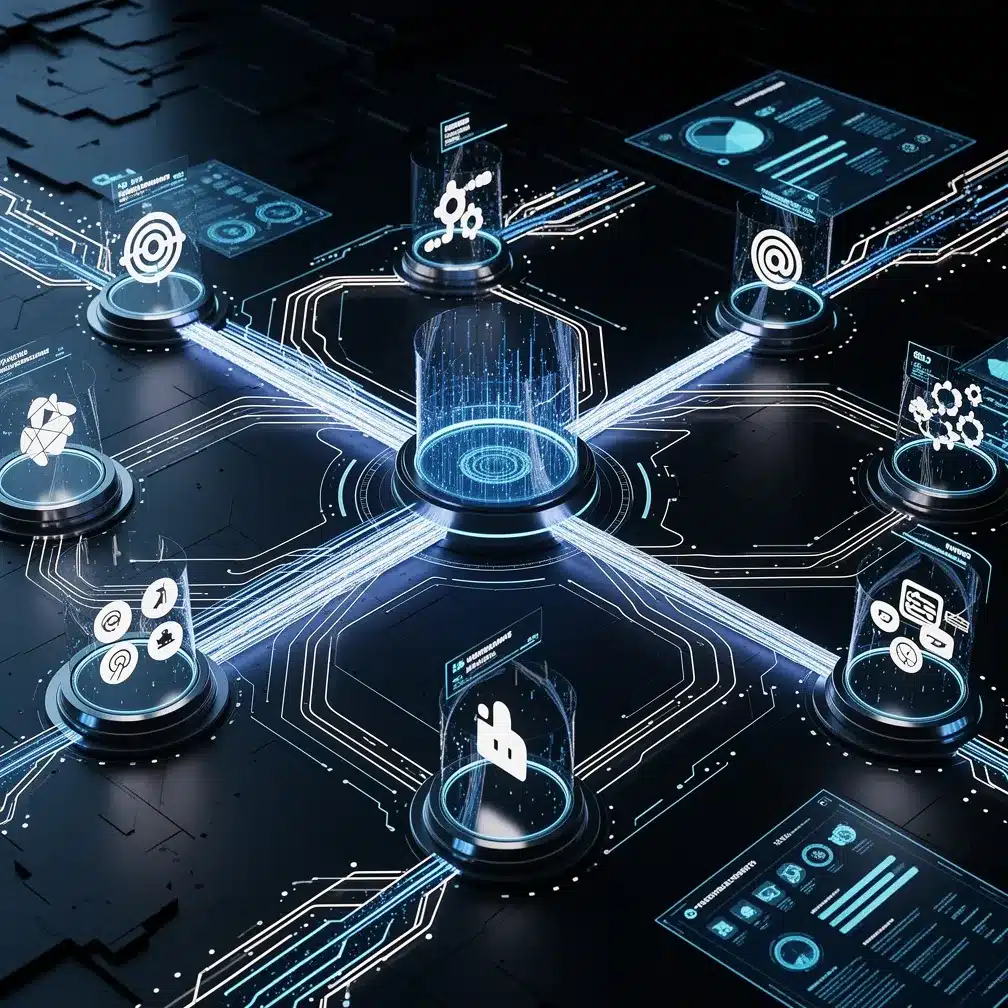
For an autonomous marketing infrastructure to operate successfully, it must be built on a robust, multi-tenant database and orchestrated by secure backend integrations. At IMOS, this technical architecture is handled by three deeply integrated core pillars:
1. Real-Time Market Intelligence
The loop begins with active discovery. The system utilizes advanced AI trend hunters to continuously scan global market data, search engine intent, and competitive footprints. Rather than relying on outdated static keyword lists, the infrastructure identifies rising interest in real-time, feeding highly optimized seed keywords into the production queue.
2. Multi-Channel Asset Manifestation
Once a high-potential trend is identified, the content engine takes over. The infrastructure automatically drafts comprehensive technical articles, structures Yoast and Rank Math SEO metadata, and publishes the articles directly to your CMS. Concurrently, the syndication engine converts the text into professional visual assets and vertical video reels featuring hyperrealistic human-like presenters, distributing them across LinkedIn, Meta, TikTok, and YouTube Shorts.
3. Conversational Sales Conversion
The final step of the loop is monetization. Traffic driven to your website by the SEO and social engines is greeted by a multi-language conversational sales concierge. Trained on your private business playbooks, manuals, and pricing structures through secure Retrieval-Augmented Generation (RAG) technology, the concierge qualifies visitors, captures hot business leads, and registers them automatically in your central database.
—
Eliminating the Human Bottleneck and Payroll Friction
Managing a human-led digital marketing and sales team is not only operationally complex, but it also carries an extremely high financial burden. Employing a specialized workforce—including a Social Media Strategist, a Video Editor, a Copywriter, and a Customer Support Specialist—easily exceeds $13,000 per month in payroll. Furthermore, human workflows are naturally prone to delays, inconsistencies, and training overhead.
An autonomous marketing infrastructure consolidates all of these specialized roles into one high-velocity, synchronized digital asset. By automating the convergence of digital, visual, and written experiences, the infrastructure operates at a fraction of the cost, completely eliminates human bottlenecks, and ensures consistent, professional communication with your audience 24 hours a day, 7 days a week.
—
Complete Operational Visibility
One of the main concerns of deploying artificial intelligence is the loss of operational visibility. However, a professional-grade autonomous marketing infrastructure solves this by providing complete transparency through an interactive, real-time activity log. From their secure dashboard, business owners can monitor every single action performed by their digital workforce—from published blog articles to captured sales leads—in a clean, categorized, and beautiful timeline interface.
To learn more about the industry standards governing digital marketing automation, explore the comprehensive Wikipedia Marketing Automation Guide.
The future of digital growth is completely autonomous. To deploy your own dedicated, secure, and automated marketing infrastructure today, visit imos.pro and activate your digital workforce on autopilot.